
Meaning of New London County Values
Three different numbers all get called a New London County property value. Each serves a separate job. Connecticut towns generally assess at 70 percent of appraised or fair market value, so the assessment is a statutory fraction rather than the whole estimate. A deed's sale line records one past transfer and can read zero or nominal, while a current market estimate takes fresh evidence and judgment the tax roll simply does not contain.
| Value | What It Is | Where |
|---|---|---|
| Assessed value | Tax-base figure, generally 70% of appraisal | Municipal assessor card and grand list |
| Market or appraised value | Assessor estimate as of a stated revaluation date | Municipal CAMA or Vision record |
| Last sale or consideration | Past transfer amount, which may not be an open-market sale | Deed, OP-236, or recent-sale field |
| Land and improvement | Components that form the assessor's total | Municipal property card |
The assessment explains the tax base. Use the appraisal only beside its revaluation date. A deed plus its OP-236 filing interprets consideration, but a buying or selling decision calls for a current appraisal or other market analysis.
Connecticut's Seventy Percent Level
The assessment ratio links assessed value to appraised value. Official municipal material in New London County describes real property as assessed at 70 percent of appraisal or fair market value. That ratio is a legal convention. It does not predict what a sale will bring. The appraisal speaks from one fixed date, while markets and buildings keep moving.
Quick math can flag a copying error. It never replaces the record, and exemptions or special classifications can shrink the taxable base while the assessor's underlying estimate holds.
New London's Revaluation Base
New London based its revaluation on October 1, 2023. The city filed the 2024 Grand List on January 31, 2025. Its reported net taxable grand list was $2,177,697,940. Keep those labels attached to every city property value. Notices went out in December 2023, and the resulting values later fed tax bills. A deed from another date reflects a different point in the market, so treat the roll as a dated municipal estimate rather than a live quote.
Norwich Value Cycles Compared
Norwich restated its real-estate values with an October 1, 2023 revaluation. It replaced the October 1, 2018 cycle before it. That gap matters. Two parcels that look alike can carry values drawn from very different market snapshots. Check which revaluation year sits behind any Norwich figure before drawing conclusions.
The Norwich assessor posts its Vision database online. It notes that assessments run at 70 percent of market value. Collection and appeals follow their own track. The New London County property tax records resource covers those steps.
Look Up New London County Value
No countywide assessor exists here. Start with the municipal assessor or GIS card, which ties the number to a local parcel ID. New London and Norwich rely on Vision-linked records, and Groton's inspected system shows detailed value and deed fields.
- Select the town and search by address, owner, street, or exact parcel key where supported.
- Copy the land, building, total appraisal, and assessed labels exactly.
- Record the grand-list or revaluation date beside every number.
- Follow the deed book and page to the municipal clerk when a sale amount matters.
- Compare the deed, OP-236, and sale line before calling the transfer a market sale.
- Assessed value
- The roll figure used as the base for property taxation.
- Market or appraised value
- The assessor's estimate as of a stated date.
- Assessment ratio
- The percentage used to convert appraisal into assessment.
- Consideration
- The amount or value stated for a transfer.
- Revaluation
- A municipality-wide reset of property appraisals.
Read Groton's Value Fields
Groton's 35 Prospect Street sample card splits value neatly. Land carries $385,800 and the building $838,900. The $1,224,700 total and $857,290 assessment show the 70 percent relationship. Building traits fill the same card, but they are assessor data rather than an inspection, and the official Groton card illustrates that layout.
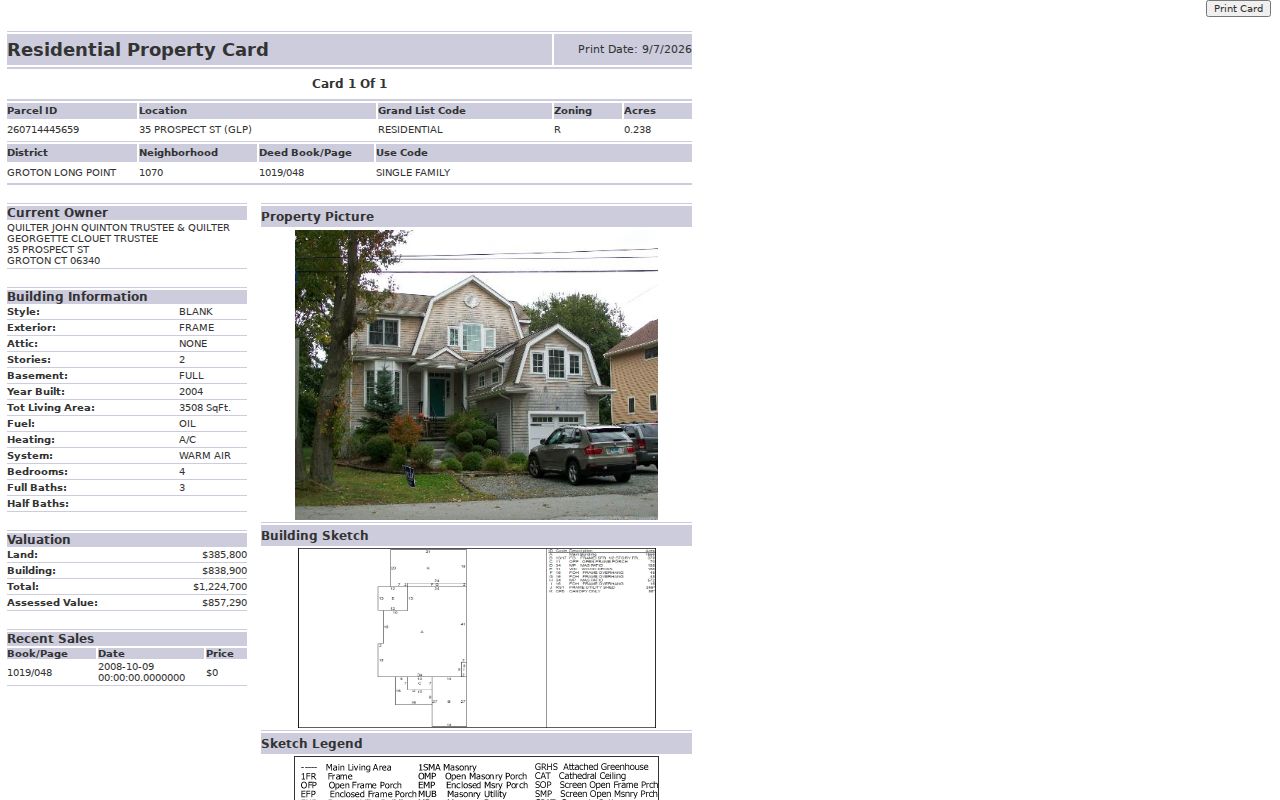
Read each field with its own date rather than merging the total, assessment, and sale line into one estimate.
Zero Sale Lines Need Deeds
$0 sale lines appear on New London County cards. The Groton residential sample shows zero. So does New London's City Pier sample. That parcel sits beside a municipal open-space one, and a zero can mark a public, exempt, nominal, or non-market transfer, or simply a CAMA display without full consideration. Pull the cited deed and check the OP-236 conveyance filing where one applies. Never treat a zero card line as proof the land lacked market value.
Groton Sources Carry Separate Dates
Groton layers its data across dates. Ownership runs current through July 31, 2026. The 2025 Grand List appeared February 2, 2026. Sketches were updated in February 2026, and aerial imagery dates to March 2023, so a New London County assessed value, owner, sketch, and map image are not one simultaneous snapshot. Regional and state layers are snapshots as well, OPM does not alter incoming municipal data, and important figures deserve a check on the town card.
Exemptions Change Taxable Value
An exemption trims taxable value. It leaves the full appraisal alone. Norwich lists veterans, elderly or disabled owners, blind residents, solar or geothermal property, and qualifying organizations among its categories. Connecticut's PA 490 covers farm, forest, and open-space land. Because of such programs, similar parcels can carry very different tax outcomes, so record the gross assessment, the exemption, and the net taxable amount as separate fields where shown.
Parcel Keys Guard Value Comparisons
No uniform parcel number spans New London County. New London records use PID and MBLU fields. Norwich leaves some MBLU segments empty, while Groton uses one long parcel ID. Preserve the punctuation, zeros, and units. The exact key keeps an address match from drifting to the wrong lot, and when land was split, merged, or converted, retain both old and new identifiers with their dates.
Recorded Sales Need Context
An assessor's recent-sale row tells only part of the story. Connecticut conveyance records fill in the rest. The grantor, an attorney, or an authorized agent files OP-236 whenever consideration reaches $2,000. An exemption can change that. Trusts, estates, limited liability companies, multiple grantors or grantees, and exemption details can all call for schedules. Some towns receive it through the free myCTREC route. The municipal clerk still holds the deed itself. Compare the named parties, the recording date, the legal description, and the consideration. Don't lift one CAMA figure. A deed may transfer a partial interest, confirm a fiduciary act, or record a transaction. That deal may be no useful comparable at all.
Building data deserves the same skepticism. Year built, living area, rooms, heat, basement, exterior, use code, and acreage are assessment fields. They are nothing more. They help explain a model. Yet they cannot certify condition or prove that later work was permitted. When a property record card seems wrong, save the exact field and its effective date. Ask the local assessor for the backing record. An estimate of your own hides the problem.
Municipal Values Cannot Be Mixed
Mill rates and revaluation dates never travel between towns. A New London figure means nothing in Norwich. Groton's named tax districts add context that a neighboring parcel simply lacks. Compare within one municipality, matching property class, value date, and kind of figure. A regional parcel download suits discovery, but check its source and updated dates before trusting it.
Exact identifiers anchor New London County values. Streets get renamed, and a parcel can lack a situs, while one condominium address may hold several accounts. Keep the local PID, the MBLU, the account number, the unit, and any former parcel references. Numbers change after a split, merger, or conversion. Compare the old and new property records then. A jump in value is not always the market.
Limits of New London County Value
A roll value is not today's asking price. A New London County property value from the tax roll guarantees no sale result, certifies no condition, and proves nothing about unpermitted work. GIS outlines do not certify lot size, and the sale line may be old, nominal, exempt, or between related parties.
Use each record for its stated public purpose and date. A licensed appraisal addresses present market value. A deed and a survey answer different questions.
Value is not an appraisal. New London County assessed value supports taxation. It is not a promise of what the property would sell for today.