
Read the New London County Current-Owner Record
Every parcel's current-owner entry lives on the assessor roll of the municipality where it sits. New London County keeps no county assessor. New London and Norwich run municipal Vision routes. Groton's documented property card shows owner, mailing, parcel, deed, sale, building, and value data gathered on a single record.
| Current Owner | Name carried on the municipal assessment roll |
|---|---|
| Mailing Address | Destination for notices, which may differ from the parcel |
| Situs | Physical property location |
| Parcel ID | Municipal account or map key |
| Deed Reference | Book/page or instrument lead for confirmation |
| Last Sale Date | Administrative sale field, checked against the deed |
The roll names an owner of record, never an occupant. That mailing address may belong to a trustee, a care-of recipient, a company, an estate, an out-of-town owner, or a privacy-program substitute. It works for lawful property correspondence. It is not proof of residence.
See Groton's Dated Current Owner Example
Groton publishes a sample residential card labeled expressly as Current Owner. Ownership is reported current through July 31, 2026. Its Grand List, sketch, and imagery each carried separate dates. That precision is the right model for any New London County current-owner answer.
The official Groton card shows the owner and mailing layout in place.
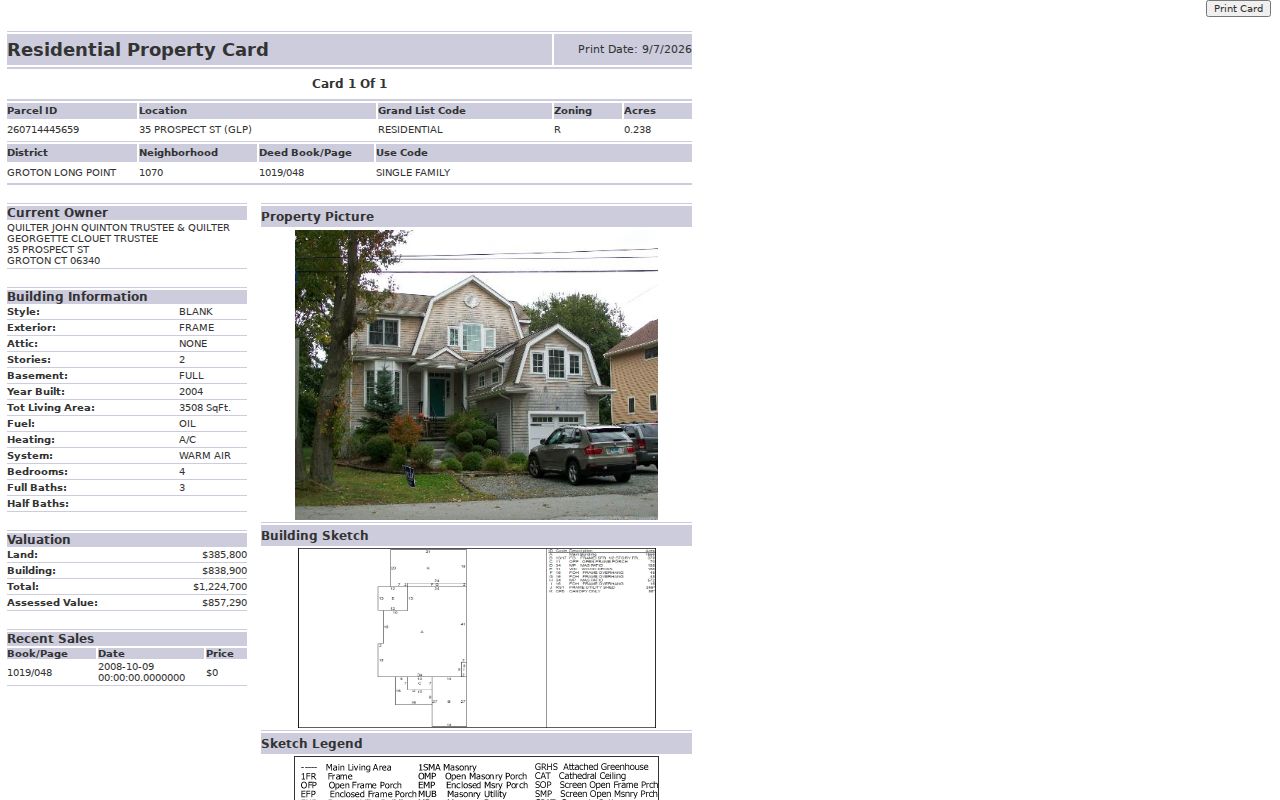
The card also shows why a source date belongs beside the name. Another section of the same record can be older without making the owner field wrong.
Measure the Gap Between Closing and the Owner Roll
A recorded deed and an assessor refresh rarely land at the same moment. Norwich warns that ownership changes may not appear on a July tax bill. It ties responsibility to January 1. A recent buyer can therefore be the newest deed grantee. An older name can still sit on a bill or roll snapshot.
Write down the deed's recording date, the assessor's ownership date, and the bill year. Never assume a uniform New London County delay. Each municipality updates on its own schedule.
Note: When the newest deed postdates the assessor card, report both names and dates and treat the recorded deed as the fresher conveyance evidence.
Confirm the Current New London County Owner
Confirmation stays inside one municipality. Use the parcel number and deed reference from the assessor card to locate the newest recorded instrument held by that town or city clerk.
- Resolve the situs municipality and open its assessor or GIS card.
- Capture Current Owner, mailing, situs, parcel ID, deed reference and source date.
- Search that municipality's clerk index for the newest matching deed and read its grantee and premises.
- Compare recording and roll dates; retain the public mailing field only for lawful property contact.
- Owner of record
- The party shown on the current assessment roll.
- Assessment roll
- The municipality's administrative property and value record.
- Recording lag
- The interval between a deed filing and another system's owner update.
- Situs versus mailing
- The parcel location compared with the notice address.
Use the Right Municipal Deed Route
New London posts its City Clerk land records online. Norwich describes subscription access instead. Several other municipalities have moved from the legacy Connecticut Town Clerks portal to RECORDhub. A changed portal never changes the custodian.
If a login wall, missing image, or online cutoff blocks the search, contact the municipal clerk, search at the counter, or request the instrument by mail. Older records may live in deed books or microfilm. An old bookmark that stops working is no sign a deed vanished.
Verify LLC, Trust, Estate, and Co-Owner Styles
The current-owner field may name a company, trustee, estate, public body, or several co-owners. Keep the exact wording and punctuation when moving into the deed index. Search reasonable spelling variants. Reject any same-name hit that fails to match the parcel or legal description.
Connecticut business filings can describe an LLC. Probate records can show fiduciary authority, yet neither replaces the deed. The controlling evidence remains the assessor snapshot weighed against the latest municipal conveyance.
Ask “Current as of What Date?”
One owner report can mix a current-owner refresh, a Grand List year, a tax cycle, parcel geometry, imagery, and a deed date. Label each part separately. The OPM and SECOG datasets may also carry different municipal vintages than a local card.
| Field | Source date | Verification |
|---|---|---|
| Owner name | Roll refresh | Newest deed grantee |
| Mailing | Roll refresh | Use only as published |
| Parcel shape | Layer vintage | Filed map or survey |
| Tax name | Billing/list year | Do not treat alone as title |
This keeps a correct but older field from being presented as a real-time fact.
Recognize a Protected Owner or Mailing Field
Connecticut Safe at Home supplies a substitute mailing address for qualifying survivors. OPM guidance also contemplates property-location substitution when an owner is nondisclosed. Respect that result. Do not try to uncover a suppressed address through some other public dataset. Do not treat a blank field as an invitation.
The task is to report the official property record accurately, suppression or blank included. It is never to build a personal profile.
When the Tax Bill Shows a Different Owner
A tax bill belongs to its own list and billing cycle. Norwich's published warning shows locally why the name can trail a conveyance. Check the bill year and the assessor refresh. Then weigh both against the deed's recording date.
Do not abandon the deed conclusion just because a bill still names the seller. Do not call a buyer current on an unverified statement either. Line up the dated records in order. Let the newest confirmed municipal conveyance settle the gap.
Reach the Current-Owner Record Online or Off
The New London and Norwich assessor databases give online starting points. Groton links maps and cards. Deed access differs by town. New London supplies a city route. Norwich describes subscription access, and several towns use Cott systems. When an index, subscription, image, or old URL fails, contact the municipal assessor or clerk directly.
A counter search, phone inquiry, or focused written request can identify the current card or newest deed. State the street address, parcel number, owner spelling variants, deed reference, and date range. Ask for older books or microfilm only if the confirmation crosses the online cutoff.
Write a Dated New London County Owner Record
Write down the owner name exactly as the assessor publishes it. Add the municipality, parcel number, situs, and mailing field. Then record the source date shown on the assessor card. Pull the same details from the deed side. Note the grantee, deed type, book and page or instrument number, and the recording date. A field may be blank, suppressed, or replaced with the property location. Copy it that way instead of filling the gap yourself. Kept this compact, the record card stays an official snapshot rather than an inference. You can also recheck it later after a closing, a grand-list update, a portal migration, or a parcel change without repeating the whole search.
Use a New London County Owner Mailing Address Lawfully
The published assessment mailing field is the right public route for property correspondence in New London County. It is not always a home address. Keep any contact narrow, respectful, and parcel-related.
Rolls can lag. A New London County owner of record may trail a recent deed. Confirm the newest recorded conveyance and never use owner information to harass or intimidate.
For the full address-to-owner method, see how to find a New London County property owner. This page stays on the current roll. Names alone can mislead. Two parties can share one, and a single owner can hold several parcels in the same municipality. Before trusting a current-owner entry, compare the parcel number and the premises along with the name. Street addresses also shift in format. The legal description and deed reference stay stable. That pair is the safer anchor when the situs wording changes. Some clerk portals show only an index row. Request the image from the municipal office. An index proves an instrument was recorded, nothing more. Its short description may hide a reservation, exception, co-owner, or other interest. The deed itself is the record to read.
A current-owner result is strongest with a brief source trail: the municipal assessor card and its ownership date, the current parcel ID, the latest municipal deed with its recording date, and a note on any tax or GIS lag. That trail keeps a later imagery date or a statewide dataset label from being mistaken for the owner refresh date. If the public roll suppresses or substitutes a field, report only what the custodian publishes.