
Trace Former New London County Property Owners
Reconstructing former owners means following the deed chain kept by the clerk of the town where the parcel lay. New London County has no county recorder. No single online starting year applies across the towns. Begin with the newest deed you can confirm, then trace recorded grantors, grantees, and premises descriptions back through time.
| Source | Years It Covers | Where Held | What It Shows |
|---|---|---|---|
| Online grantor-grantee index | Varies by municipality | City/town clerk portal | Parties, dates, type and instrument lead |
| Deed books and microfilm | Older local record era | Municipal clerk; preservation copy where held | Earlier conveyances and descriptions |
| Filed maps and surveys | Town-specific | Municipal clerk; SECOG discovery route | Lot identity, map reference and subdivision context |
| Archives and historical collections | Nineteenth century and other historical material | State Library and historical society | Indexes, court context and research leads |
Search online only where the town's records reach. When the portal stops, move to the clerk counter and the older volumes. Historic collections can support the chain, provided every ownership step still ties to the same premises.
Start With the Latest Recorded Grantee
Pull the current municipal card first. It should give the owner of record, a parcel number, and a deed book and page. It may instead show an instrument lead. Open the newest matching deed. Copy the grantee exactly, down to trustees, estates, companies, initials, and co-owner wording.
A premises clause and prior book and page outlast any modern street address. So do the map reference and the legal description. Record both dates. The execution date and the recording date answer different questions about the timeline.
Note: A same-name index result does not join the chain. It joins only if its premises or legal description matches the subject parcel.
Follow Each Town's Own Land-Record Portal
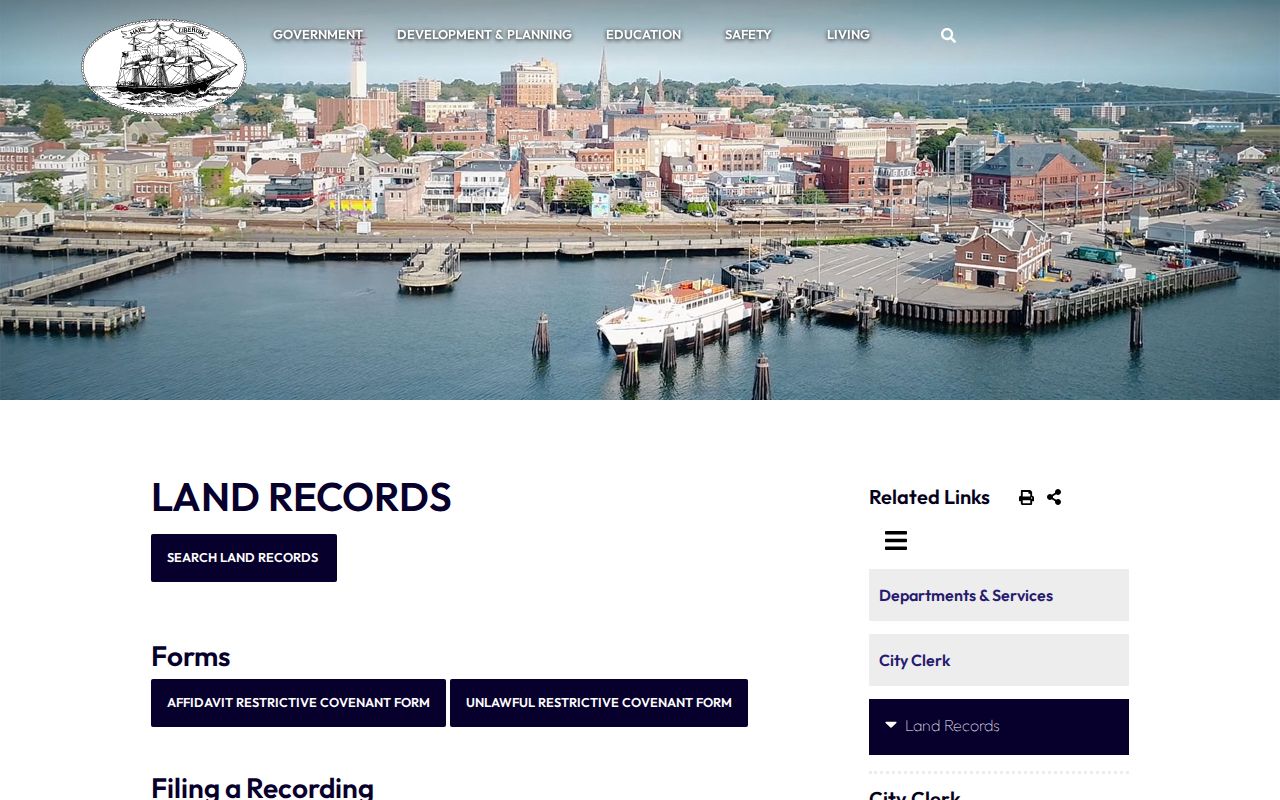
Each town runs its own land-record portal. New London offers a City Clerk land-record page, Norwich points to a subscription service, and several towns have moved from the older Connecticut Town Clerks portal to RECORDhub. Search fields, subscriptions, images, and depth all differ from town to town. The New London page shows the official route.
Every deed belongs to the town clerk. A portal only goes so far. When an image is blocked or the index ends before the year you need, contact the clerk's office by phone, in person, or in writing, and ask for the index entry, the deed book and page, and any referenced map. The Connecticut Freedom of Information Act lets you request records from the agency that holds them. That law is powerful. A municipal deed still stays a municipal record.
Walk a New London County Deed Chain Backward
The backward method is simple. Each seller becomes the next search subject. Keep a running table of every step so a shaky match, a missing reference, or a changed jurisdiction stays visible instead of getting smoothed over.
- Find the current acquisition deed and write its grantee, grantor, date, type and identifier.
- Search that grantor as an earlier grantee, using spelling and date variants.
- Match the earlier premises, map and prior-instrument clues before adding the transfer.
- Repeat until online depth ends, then continue in clerk indexes, deed books or microfilm.
- Grantor and grantee
- The conveying and receiving parties named in an instrument.
- Chain of title
- The ordered sequence of conveyances tied to the same land.
- Reverse index
- An index organized to find the relevant party role while tracing backward.
- Quitclaim versus warranty
- Different deed forms whose legal effect should be read from the instrument, not guessed from a label.
| Transfer date | Grantor to grantee | Deed type | Book/page or instrument |
|---|---|---|---|
| Newest confirmed date | Prior owner to current grantee | Copy exact label | Record both identifiers shown |
| Earlier confirmed date | Earlier grantor to later grantor | Copy exact label | Link through premises reference |
| Unresolved step | Do not infer parties | Mark the gap | Move to books, map or probate |
Use Parent-Town History for Older Ownership
Town lines matter more as you go back. Groton split from New London in 1705. Ledyard split from Groton in 1836. A deed from before either separation may therefore sit under the parent town's historical jurisdiction. New London and Norwich city and town wording can also shift in old material while the records still answer to the municipal clerk. Preserve the historic place label in your chain table and note how it relates to the modern parcel.
Bridge Probate, Foreclosure, and Fiduciary Transfers
A tidy buyer-seller sequence can break apart. An owner may have died, a trustee or conservator may have acted, or foreclosure may have changed hands. Search the index for executor, administrator, trustee, conservator, estate, lis pendens, judgment, and foreclosure-deed terms. Probate records explain the authority. The deed must still match the land. Online court documents depend on return date and case type, so older gaps may call for a courthouse visit.
Extend the Chain Through Books, Maps, and Archives
The Connecticut State Library's municipal historic-documents program explains why some older volumes survive only on microfilm or in a finding aid rather than online. Ask the town clerk what remains in the vault. Ask whether a duplicate copy exists.
Archives widen the trail. The New London County Historical Society research archive offers appointment-based in-person research and paid staff research. State Library county court indexes and files reach nineteenth-century material, and SECOG offers map and survey discovery. These sources add context and leads. They never replace the municipal deed link itself.
Investigate a Zero-Dollar Sale Instead of Guessing
Groton's residential and exempt cards show it. So does the New London City Pier sample. The $0 recent-sale field can reflect a nominal, public, exempt, or non-market transfer, or simply missing consideration in the CAMA presentation. Pull the deed and the OP-236 conveyance record. A $0 administrative sale field never means the land had no market value.
Record Alternate Names Without Joining the Wrong Chain
The same owner can appear under many names. Initials and spelling variants show up in the books. So do married names, trustee styles, estate captions, companies, and parent entities. Test each variant in both grantor and grantee roles across a sensible date window. Then demand a matching premises description, map reference, parcel lineage, or prior deed citation. A name alone is weak evidence. Municipal indexes hold plenty of unrelated parties. Keep rejected candidates in a research note so they will not be mistaken for missing links later.
Capture Every Identifier in a Former-Owner Chain
Every transfer in a former-owner chain deserves the same careful capture. Record the execution date, the recording date, the grantor, and the grantee. Note the exact deed type, the book and page, and the instrument number. Add the consideration field when it appears. Keep any legal-description clue tying the document to the parcel. Keep the town name as it stood at that time.
A deed often points somewhere useful. If it references a filed map, pull the official municipal copy. Do not settle for a private transcription. If it cites a prior instrument, follow that direct reference. Do not settle for a broad party-name search. Those connections are what make the parcel history auditable.
Know How Far New London County Ownership Records Go
There is no honest countywide online cutoff for ownership records. Coverage varies across the county's twenty-one municipalities. The county publishes no uniform starting years for New London or Norwich. State archives and historical collections can reach much earlier than a current portal. Still, their existence does not prove an unbroken chain for one parcel.
Online depth varies. Do not invent a cutoff year. Continue older New London County former-owner work through the municipal clerk's books, microfilm, filed maps and verified archives.
End the search at a verified legal description. If a map's identity, a gap, or an interest stays uncertain, let a title professional assess it. A surveyor can also assess the original instruments. For a single recorded instrument, the New London County deed records guide explains how to obtain it. It also explains how to read it.
Historical tax lists, directories, newspapers, and local-history works can enrich a house history. Treat them as secondary or contextual evidence. A resident, taxpayer, or business at an address was not necessarily the deed owner. Keep such clues in a separate column until a recorded transfer connects them. Another authoritative land record can connect them too.
Portals migrate, and records do not vanish simply because a search box did. Ask the clerk which system now holds the current index and which route retains legacy images. A search that disappears after the move from the old Cott portal to RECORDhub is not proof. It does not prove an instrument was removed. Subscriptions and image permissions may also change without altering the record itself.
The finished product should show a series of verified transfers. It should not be a list of people who matched a surname. Mark unresolved intervals, fiduciary steps, municipal boundary changes, and missing prior references. That honesty makes a New London County former-owner timeline more useful. It helps with house history, estate research, and purchase diligence. Never use a historical chain to locate or harass a living person.