
Deed Types Recorded in New London County
Municipal clerks in New London County record far more than simple sales. A deed transfers an interest, sure. Mortgages, releases, liens, easements, restrictions, and maps also touch the parcel. None of them act as a sale deed. The document type tells you what the instrument actually did. Read it before assuming ownership moved.
| Deed Type | What It Does | Common Use |
|---|---|---|
| Warranty deed | Conveys the stated interest with covenants | Conventional arm's-length transfer |
| Quitclaim deed | Conveys whatever interest the grantor has | Family, entity, or title cleanup transfer |
| Fiduciary or executor deed | Transfers through an authorized fiduciary | Estate or trust administration |
| Foreclosure deed | Records a transfer following foreclosure procedure | Post-judgment transfer |
| Correction deed | Corrects a recorded conveyance detail | Name or description correction |
Never conclude from an index row alone that ownership changed. A nominal or $0 sale line is a prompt. It is not proof. Such lines tell you to inspect the deed and the conveyance return. The deed itself reveals whether the transfer carried real value or served another purpose entirely.
Municipal Grantor-Grantee Indexes
New London County deed records rely on municipal grantor and grantee indexes. New London publishes its own city land-record route, while Norwich runs a subscription system. Other towns may sit on the legacy Connecticut Town Clerks portal or on RECORDhub. Participation, subscriptions, images, and start dates all differ. So one town's screen coverage never guarantees another's.
- Find the current owner's acquisition instrument with the owner indexed as grantee.
- Copy the grantor, recording date, book/page or instrument number, and prior reference.
- Search that grantor as grantee to locate the preceding acquisition.
- Repeat while comparing the legal description, and move to books or microfilm when online coverage ends.
- Grantor
- The party conveying the stated interest.
- Grantee
- The party receiving the stated interest.
- Chain of title
- The ordered series of instruments connected to the same land.
- Book/page or instrument number
- The clerk's retrieval reference for the recorded document.
Fields in a Cott-Style Deed Search
| Control | How to use it | Caution |
|---|---|---|
| Last/Firm, First, Middle | Search people or entity names and variants | Punctuation and trustee wording can differ |
| Party | Select grantor, grantee, or both | Direction changes with the research question |
| Date range | Limit the recording period | Execution and recording dates may differ |
| Index, group, kind | Narrow document category | Do not exclude releases or corrections too early |
The Connecticut Town Clerks portal offers a representative search interface, and RECORDhub serves as the newer Cott entry point. Confirm the selected town and its stated coverage first. A no-result search means nothing until the coverage window matches your deed dates.
Book, Page, Instrument, and Date Clues
A strong New London County deed-record entry captures party names. Document type, execution date, and recording date appear too. It also shows consideration where displayed, book and page or an instrument number, and the legal description. Prior references appear as well. Recording date marks when the clerk accepted the document. It may not match the signing date or the assessor's roll update.
Carry each reference exactly as written, leading zeros and punctuation included. Parcel identifiers are municipal too, not countywide. Before linking one deed to the next, compare premises language and lot or map citations. Check the bounding owners too.
Mortgages, Releases, Liens, and Easements
A New London County deed chain review reaches beyond conveyance deeds. Search the ownership period for mortgages, assignments, and releases. Add mechanic's liens, tax liens, lis pendens, easements, restrictions, condominium declarations, and corrective instruments. A release can matter as much as the original lien. An unreleased index hit says nothing about present status by itself.
State business and UCC sources add entity and financing context. But the municipal clerk stays the land-record custodian. Court dockets can supply foreclosure or quiet-title history. Still, allegations and notices never replace the final judgment and the recorded deed.
Plats and Legal Descriptions Behind the Deed
New London County deeds describe land in several ways. A parcel may be defined by lot and block, metes and bounds, condominium unit, filed map, or a prior deed. Use the SECOG maps and GIS route for discovery. Then get the authoritative filed map from the municipal clerk. GIS parcel lines are informational and may simplify the legal description.
Historic jurisdiction matters for parent-town records. Groton split from New London in 1705, and Ledyard from Groton in 1836. An early deed link may therefore sit under a predecessor town's books. Document both the historical and modern municipality rather than silently bridging them.
Online Coverage Stops at Different Years
No single official online starting year covers all 21 municipalities. New London and Norwich publish no uniform cutoff on their cited pages either. When the web index ends, contact the town or city clerk. Reverse indexes and deed books may carry the chain further. Maps and vault material can help too. Microfilm or an appointment may also extend the record. Mail requests and Connecticut FOI requests open additional channels when travel is impractical.
Historic research can continue through the Connecticut State Library. The New London County Historical Society and the New London Public Library are further options. Those collections may hold indexes or secondary materials rather than recorded originals. Cite their status carefully, and return to the clerk's volume when you need proof.
Coverage warning. There is no countywide online cutoff year; confirm the selected municipality's depth and use its vault for older deeds.
New London Clerk Access in Practice
The New London City Clerk land-record page spells out municipal recording directly, with forms, access details, and fees. Recording there ends at 3:45 p.m. per the page. Confirm current hours before you travel, since schedules change.
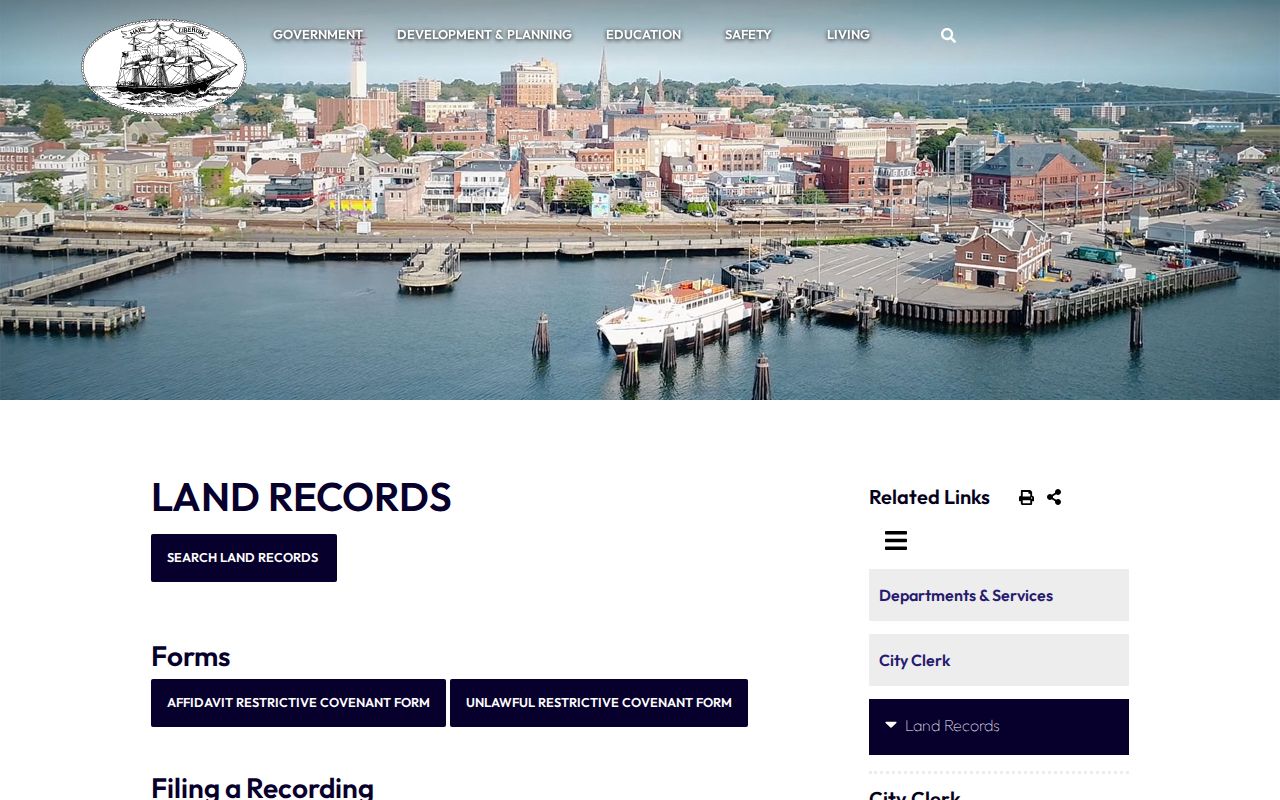
The official page shows the local-office model plainly: a New London deed is handled there, while a Norwich, Groton, or Stonington deed belongs to its own clerk.
Copy Charges and Deed Solicitation Cautions
Recording fees in New London County follow CGS §7-34a. That statute sets page fees and possible special charges. Copying is separate: plain copies, certifications, portal subscriptions, and images each carry their own charges. Under ordinary municipal FOI rules the ceiling is generally fifty cents per page, though land-record certification and statutory schedules can control a particular request.
Beware mailed deed-copy solicitations. The Connecticut Department of Consumer Protection has warned homeowners about private services charging steep prices for what the clerk provides cheaply. That call to the municipal clerk takes minutes. Ask what an official plain or certified copy costs before paying anyone. Providing the municipality, the parties, a date range, the document type, and the book/page or instrument number cuts search time.
A certification covers only the clerk's copy. It does not certify clear title or the present condition of a boundary. Say whether the copy is for informal research, a transaction file, court submission, or another purpose, so the right form is chosen without assuming more than the document proves.
Court and Probate Transfers Can Interrupt the Pattern
Not every deed records a sale. Foreclosure, quiet-title, partition, probate, and fiduciary events can build a chain. That chain may look nothing like a purchase. Search the municipal index for lis pendens, foreclosure deeds, fiduciary deeds, certificates, and related releases. Then pull docket context from the Judicial Branch Civil Inquiry. Public internet documents vary by case type and return date. So a courthouse terminal or clerk request may still be needed.
Probate records run through Connecticut probate districts, not a county clerk. An estate inventory or decree can explain who had authority and who succeeded. Check the final transfer in the parcel's municipality. Keep court allegations, orders, and recorded instruments labeled separately. Blurring them distorts the chain.
Preserving a Chain Research Log
A research log keeps a deed chain honest. For each link, record the municipality, transfer date, and recording date. Note the grantor, grantee, and document type as well. Add the book/page or instrument number and any legal-description or map clue. Add the prior instrument reference too. Note the portal or volume searched, plus its coverage dates. This discipline prevents a classic error. It stops you from merging two people who share a surname and nearby dates. Flag unresolved spellings, missing releases, changed parcel boundaries, and predecessor-town references. Do not smooth them over.
Execution and recording dates need separate columns. A deed may be signed long before recording. Assessor ownership and the next tax bill can update later still. When a legal description cites a filed map, a condominium declaration, or a “same premises” clause, capture that citation first. Then move to the prior owner.
A missed name-index entry is not the end. A second search by date and document kind can often recover what the name index missed. For legal reliance, hand the log and copies to a qualified title professional. A web index alone cannot declare title. The chain holds only when every transition is supported by an instrument. It also requires the same parcel identity, not merely a recurring street address.
Getting a New London County Deed Copy
Check the municipal portal first. An image may already be posted. If not, request an uncertified or certified copy from that New London County town or city clerk at the counter or by mail. Older books and maps often need vault or staff help. State whether a research image suffices or an official certified copy is required. Confirm cost and payment method directly.
Recorded, not guaranteed. New London County deed records show instruments accepted by a municipal clerk. They are not a title opinion, and unrecorded interests or unresolved defects may exist.