
What New London County Tax Records Contain
No single county tax roll exists here. New London County tax records actually pair two linked municipal files: the assessor's valuation record and the collector's account, each kept in the town where the parcel sits.
| Field | What It Shows | Where |
|---|---|---|
| Land, building, total | Components of full appraised value | Municipal assessor card |
| Assessed value | Taxable assessment tied to a grand list | Assessor roll |
| Exemptions | Approved statutory or local reductions | Assessor files |
| Bill and installments | Charges, due dates, credits, balance | Tax collector |
| Interest and delinquency | Accrued charge or collection status | Collector and recorded liens |
| District charges | Local additions applicable by location | Collector and district records |
A tax bill is not a sale appraisal. Sale price, full-value estimate, assessed value, and balance due answer different questions, and each can carry its own date.
Look Up a Municipal Tax Account
Start by resolving the municipality. Pull the parcel ID from that town's assessor. Then run it through the local collector's inquiry; New London, Norwich, and Groton each publish separate schedules, and one city's calendar or rate never fits another town.
- Search the assessor by situs and copy the exact local parcel identifier.
- Open that municipality's collector portal and locate the account.
- Read year, installments, payments, credits, balance, and interest separately.
- Return to the assessor for values, exemptions, and grand-list date.
- Confirm payoff or disputed status directly with the collector.
- Assessed value
- The value carried on the taxable roll.
- Mill rate
- Tax dollars per $1,000 of assessed value.
- Exemption
- An approved reduction for a qualifying property or owner.
- Tax lien
- A recorded claim securing unpaid tax, distinct from the portal balance.
Connecticut's 70 Percent Assessment Level
Connecticut municipalities explain that assessment is generally 70% of fair market value. The ratio is not a current sale price. It rests on the town's revaluation base. Before comparing values, record the town, valuation date, property class, and whether any later physical change has been folded in. The final bill turns on more than the ratio. Apply the correct year's mill rate, exemptions, credits, and district charges to reach the number the collector actually issues.
New London's 2023 Revaluation
New London ran a citywide revaluation on an October 1, 2023 base. Notices went out in December 2023. Those values then drove the July 2024 billing. The New London revaluation page explains the cycle, the hearing route, and the assessment level, and the New London Vision database provides the assessment-search entry.
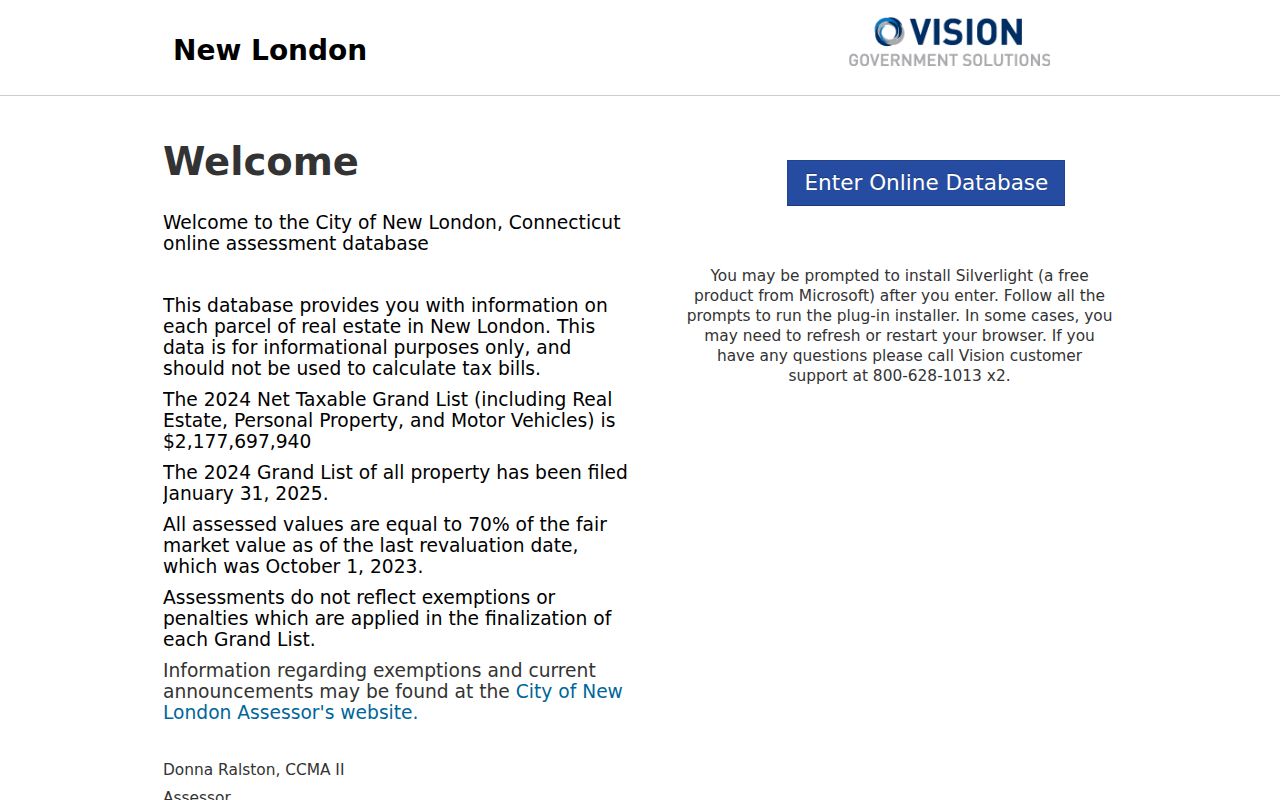
The database's live grand-list date and disclaimer shift. Check both on every visit; the on-screen figures reflect the city's current posting, not a permanent roll.
Norwich's Revaluation and Tax-Bill Lag
Norwich went through a 2023 revaluation. Its prior cycle had an October 1, 2018 base. Separate baselines mean an earlier roll will not line up with a later sale or a different municipality. Norwich revaluation information supplies the local dates. The city also warns that ownership changes after the end of May may not appear on a July bill, while January 1 responsibility controls. Deed, assessor refresh, and bill can therefore name different parties without any record being wrong.
Rates and District Additions Stay Local
New London published a 27.10 mill-rate example. It added a 0.99 city-center district component. Those figures fit one city and one period only. Groton maps its named tax and fire districts, and every other town sets its own rates and boundaries. A label like City of Groton, Groton Long Point, Noank, or Mystic does not guarantee a separate deed office. Calculate with the exact year's assessed value and the applicable municipal and district rates. Then compare your result with the issued bill.
Note: Never transfer New London's rate or installment calendar to another New London County municipality.
Installments, Interest, and Payment Evidence
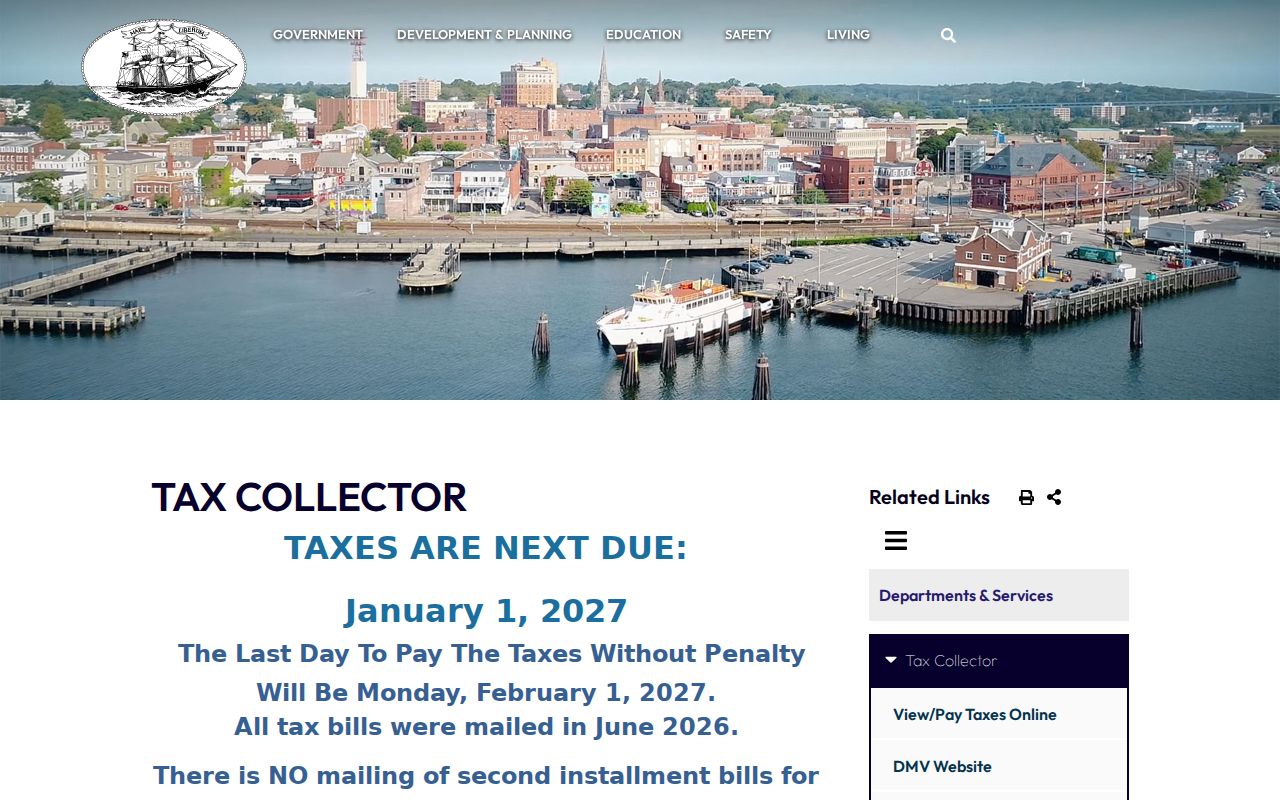
New London and Norwich publish their own installment calendars. Local sources describe 1.5% interest and minimum-charge rules, plus returned-check and online-payment costs. Schedules and vendor fees change. Rely on the current collector page. The New London Tax Collector lays out the city's payment routes.
The separate tax-bill inquiry provides account lookup.
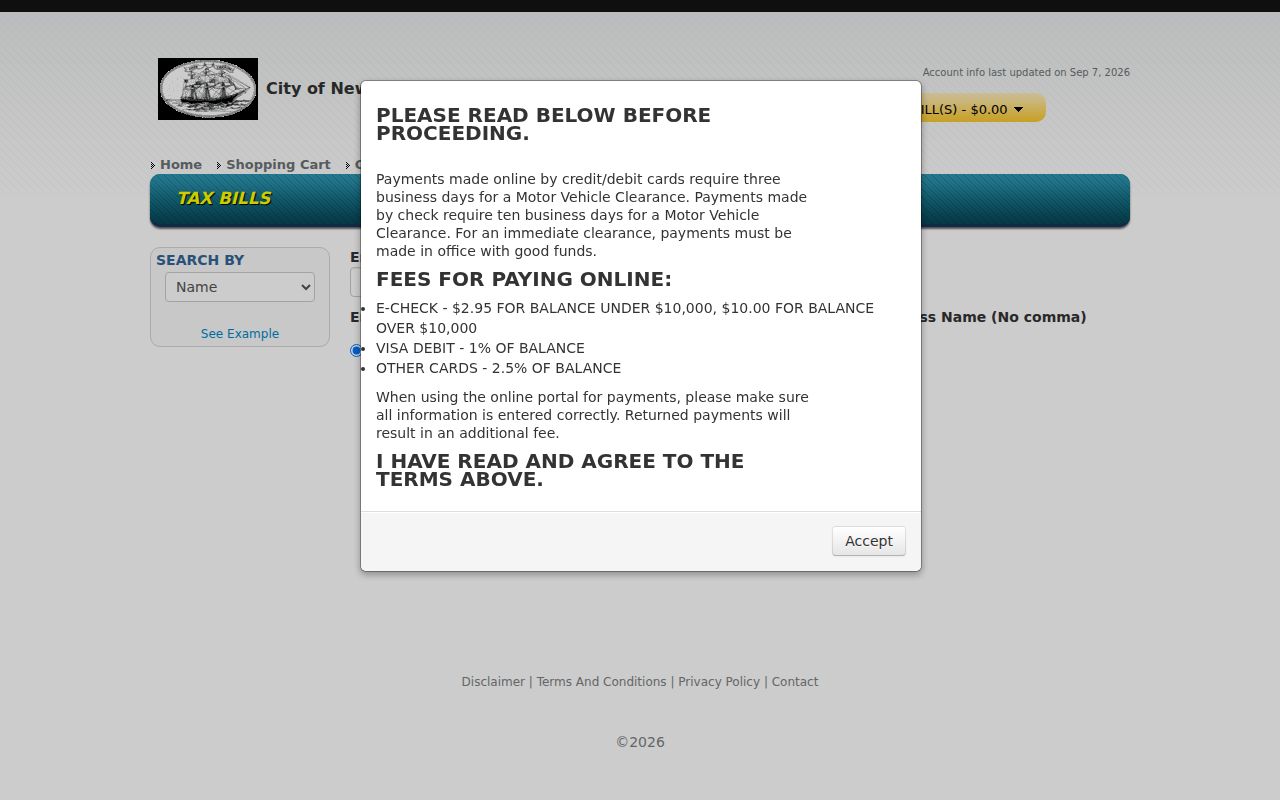
Confirm a time-sensitive balance directly, especially after payment, reversal, or transfer.
Exemptions and Current-Use Programs
The Norwich assessor lists veteran, elderly or disabled, blind, solar or geothermal, and qualifying-organization categories. Open space, farm, and forest land follow PA 490. Eligibility belongs to the assessor. A Norwich listing never creates countywide eligibility.
Ask that office for the current application, qualification date, documentation, and effect on taxable assessment. The collector applies the bill. That office cannot replace the assessor's determination.
Preserve the application year and the exact value category in any exemption research. A program can shrink an assessment without touching full market value. A benefit on one grand list may need renewal, income verification, ownership evidence, disability proof, military records, or continued qualifying use. If an expected exemption is missing, ask whether it was denied, expired, transferred, or tied to a different tax year. The collector's payment screen holds no administrative history.
Delinquency, Liens, and Court Context
A portal balance is only one clue. Confirm the account with the collector. Search municipal land records for tax liens or releases, and check any sale or court notices. A lien does not itself prove title transferred. Connecticut Civil Inquiry may add docket and disposition context, though public internet documents depend on case type and date, and courthouse access can still be necessary.
Read Land and Building Values Separately
Municipal cards split land, building, total, and assessed amounts into separate fields. A building figure is an administrative valuation component. It is not an inspection, a construction bid, or proof that every improvement was permitted. When a physical change matters, compare the card's use, area, year, sketch, and characteristics against municipal permit records.
A $0 sale line needs context too. Groton sample cards and a New London City Pier example carry $0 entries reflecting public, exempt, nominal, non-market, or incomplete CAMA consideration. Pull the deed before declaring a zero sale. The OP-236 conveyance material tells the real story.
Requesting Tax Records That Are Not Online
Deed recording, assessor ownership, the grand list, revaluation, tax billing, payments, the parcel layer, and imagery each carry their own dates. The newest tax payment does not update the deed. A new deed may not change the July bill. Groton property cards show this split clearly. They display separate currency lines for ownership, the roll, the sketch, and imagery.
For 2026 work on a New London County parcel, reopen the assessment card, the current tax inquiry, and the clerk index. Download the newest parcel snapshot only when geography matters. Note what a result mixes. It may combine 2023 revaluation facts, 2024 GIS data, a later grand list, and a current account. Visible dates prevent false precision.
Know which office holds which records. The municipal assessor keeps roll cards, valuation worksheets, exemption applications, hearing material, and answers on property class. The collector handles bills, payment histories, and payoffs. Delinquency, interest, and returned-payment details also sit there. Ask the clerk for recorded tax liens and releases. Older rate or assessment research may lead to municipal archives, the Connecticut State Library, or the New London County Historical Society.
Put the request in writing. That distinguishes the issued bill from a ledger or payment history. Ask whether the response will show the original levy, adjustments, credits, interest calculations, returned payments, releases, and a balance through a specified date. For assessment files, request the property card, revaluation worksheet, comparable-sales material, inspection notes, exemption determination, and any Board of Assessment Appeals filing, where those records exist and are public. Naming these items beats a summary screen.
Historical rate research needs the municipality and the year. New London, Norwich, Groton, and special districts never shared one county levy. Keep the grand-list year, fiscal or tax year, installment schedule, and district name in every citation. Early county history volumes add rate-list context. Label that secondary or digitized material clearly, and never let it replace the municipality's original tax record.
A Connecticut FOI request goes to the actual custodian. Identify the municipality, parcel, street, owner as displayed, tax or grand-list year, desired fields, and format. Municipal copies generally carry a $0.50-per-page ceiling under FOI rules, with separate provisions for certification and electronic costs. Confirm the estimate before ordering a large file.
Appeal a New London County Assessment Locally
Assessment appeals stay municipal in New London County. Start with the current assessor's review instructions. Then file with the local Board of Assessment Appeals. Strong evidence names the owner or appellant, the parcel, the property type, the challenged category, a stated reason, any representative authorization, the owner's estimate, and comparable or condition support. The available New London 2022 BAA form is a historical field example, not a current deadline source.
Appeal window. Deadlines follow each municipality's grand-list and revaluation calendar. Verify the current Board of Assessment Appeals date rather than reusing a historical form.