
Find Out Who Owns a New London County Property
New London County has no county recorder for land records. Connecticut keeps assessment rolls and deeds at the town and city level instead. Start by fixing the situs town. Mystic addresses and the City of Groton sit inside the Town of Groton. Then trace the parcel through that municipality's own systems.
- Search the situs address in the correct municipal assessor or GIS database.
- Record the Current Owner, mailing address, parcel ID and deed reference.
- Confirm the grantee and legal description on the newest deed in that municipality's clerk index.
- If a trust, estate or company appears, keep that exact name and use probate or state business records only for context.
Pick the Municipality Before the Owner
New London County contains twenty-one municipal land-record custodians and no active county land-record office. New London and Norwich operate as coextensive city and town governments. Groton adds its own recurring city-versus-town wrinkle. A ZIP code or village label never picks the clerk.
Let the parcel map resolve the municipality. District names such as Noank, Groton Long Point, Navy, Mystic, and Old Mystic describe local geography. They do not serve as separate deed offices.
Note: Record the municipality and source date beside every owner answer so another reader can reproduce the search.
See the Current Owner Field on Groton's Card
Groton's property card places a labeled Current Owner field alongside mailing, parcel, deed, sale, building, and value fields. The card states its owner data is current through July 31, 2026, while other card and map elements carry their own dates. Open the official Groton residential card to see that field arrangement for yourself.
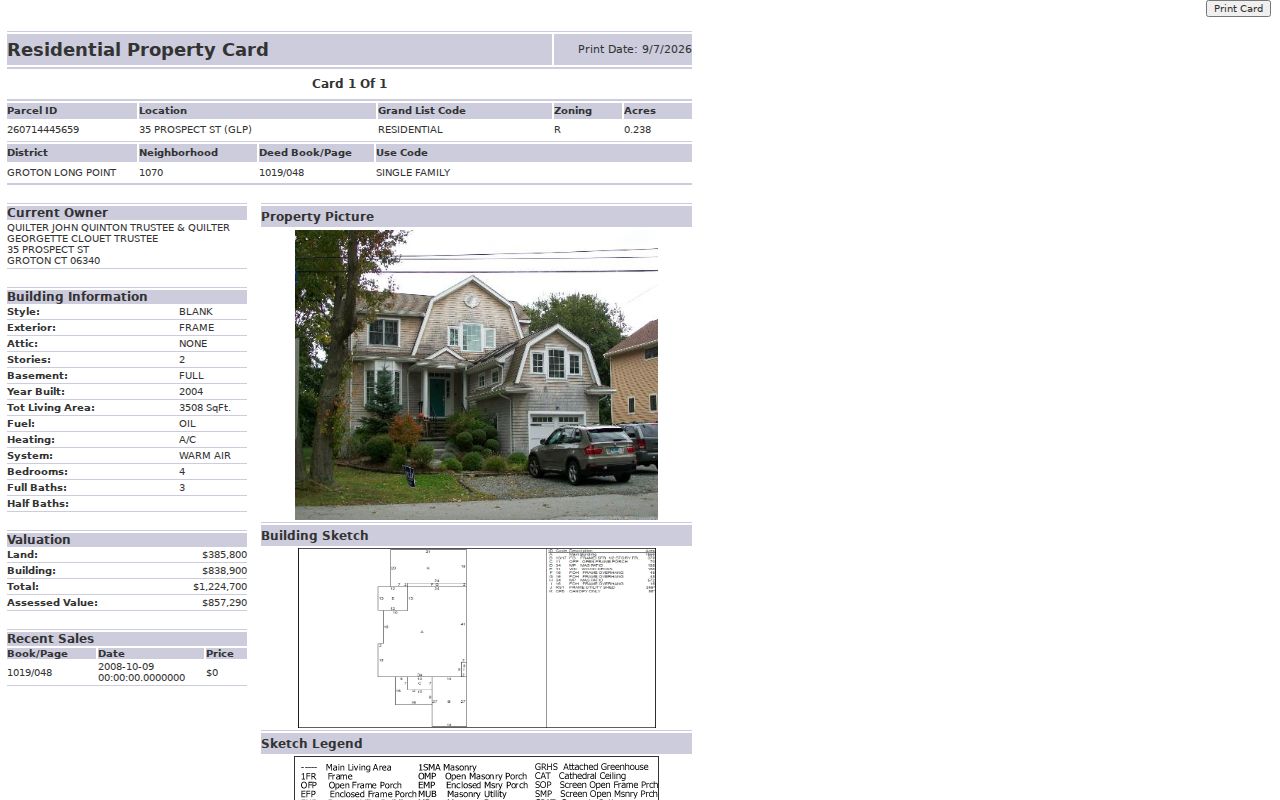
The card's own date labels show why any owner answer must name both parcel and date. Treat the card as a strong starting point. The latest recorded deed then supplies confirmation.
Compare New London County Ownership Sources
Each official source answers a different slice of the ownership question. Compare them. Never treat the first name found as proof of title.
| Source | Owner Info It Gives | Access |
|---|---|---|
| Municipal assessor roll | Current owner, mailing, situs and parcel ID | Municipal database or counter |
| Municipal clerk index | Grantee and recorded deed reference | Portal, office, request, older books |
| Business.CT.gov | Company filing context | State business search |
| Municipal or SECOG GIS | Parcel location and linked CAMA fields | Free viewer or download |
Mailing and situs addresses serve different purposes. A mailing field may show a care-of recipient, an out-of-town owner, a trustee, an estate, a company, or a protected substitute address. It cannot establish who occupies the property.
Confirm a New London County Property Owner by Deed
Bring the deed reference or owner name to the clerk of the same municipality. New London offers a city land-record route. Norwich requires a subscription for online land records. Other municipalities may rely on the Connecticut Town Clerks portal or RECORDhub.
Read the grantee, recording date, deed type, and premises description carefully. Online coverage or image access may stop. Then use the clerk counter, a phone call, or a written request. Older deed books, microfilm, the State Library, and the New London County Historical Society cover earlier eras. Use them as needed.
Reconcile the Four Dates Behind an Owner Answer
Deeds, assessor rolls, tax bills, and GIS layers each carry their own effective date. Norwich cautions that a July tax bill may not reflect a recent ownership change. Responsibility still falls on whoever owned the land on January 1. Groton goes further. It stamps separate dates on ownership data, Grand List details, sketches, and aerial imagery, so a parcel can show one owner of record in one layer and another in a layer updated later.
| Record | Date to capture | Meaning |
|---|---|---|
| Deed | Recording date | Recorded conveyance |
| Assessor | Owner refresh | Roll name at that snapshot |
| Tax bill | List or billing year | Bill recipient for that cycle |
| GIS | Parcel and imagery dates | Mapped location and visual context |
When a new deed postdates the roll, report the difference plainly rather than silently picking one name.
Read Trust, LLC, Estate, and Co-Owner Names as Written
Copy the owner style exactly as written. Initials, trustee wording, estate language, and punctuation all matter. Search those exact variants in the clerk index. Connecticut business records can explain an entity name, though corporate status alone never proves the entity owns the parcel.
- Owner of record
- The name carried on the assessment roll.
- Grantee
- The party receiving an interest in a recorded deed.
- Title
- The legal property interest, not a synonym for one database field.
- Situs
- The physical parcel address, distinct from owner mailing.
A probate file or civil docket may explain authority or a dispute.
Tie any supporting record back to the recorded parcel instrument.
Respect Protected New London County Address Fields
Connecticut Safe at Home can give qualifying survivors a substitute mailing address. OPM parcel guidance also describes property-location substitution. That applies when owner information is nondisclosed. A masked or property-named field may be intentional.
Never try to defeat a suppression through voter, vital, court, or commercial sources. Property-owner research should stay tied to purchase diligence, boundaries, estates, and civic transparency.
Use Court and Probate Records Only When the Deed Trail Calls for Them
Why would the current name differ among sources? A foreclosure, quiet-title case, partition, mechanic's lien, lis pendens, or probate transfer may explain it. New London Judicial District serves the county's municipalities. Public internet documents depend on case type and date. A courthouse terminal or clerk request may be needed for older material.
Probate districts, not the geographic county, handle estate authority. Watch for an executor, administrator, trustee, conservator, or estate reference. Then locate the resulting fiduciary deed or order in the municipal land record. Court and probate records remain supporting context until tied to the same parcel.
Keep an Offline Route for Every Property Owner Check
Online access can require an account, omit older images, or shift during a Cott-to-RECORDhub transition. The fallback is the city or town clerk counter. A phone or written request can follow. Ask for a named deed, index entry, or map. For assessment fields, contact the municipal assessor when a card is unavailable or unclear.
For older ownership questions, ask about deed books, microfilm, and preserved volumes. The Connecticut State Library and the New London County Historical Society help locate historical material. Neither replaces the present municipal land-record custodian. So route current work to the town.
Build a Reproducible New London County Owner Note
A good owner note stays reproducible. List the municipality first. Add the situs address, parcel number, and the assessor source date. Then record the exact owner style as printed. Record the mailing field as published, and the newest deed reference with its recording date. That gives anyone a clean path back to the original entry.
Report mismatches openly. A grantee newer than the tax-bill name is a timing gap worth explaining. It is not two names to merge into one. Keep the search terms you used for any entity or trustee, plus the source that settled the town. A later portal refresh, parcel split, or owner update can then be checked against the same trail.
Know What a New London County Owner Lookup Cannot Tell You
An assessor name has limits. It is not a title opinion, not proof that anyone lives there, and not a full picture of beneficial interests behind a parcel. A transfer may still be pending. A deed may sit unrecorded. Or a trust or company may stand between the land and the individual. Rely on the newest recorded deed evidence you can find. Say plainly where uncertainty remains.
Lawful use. A New London County owner lookup supports property diligence and research. Never use owner information to stalk, harass, intimidate, or harm anyone.
The current owner record guide centers on roll freshness and the latest deed. Tracing owners backward is a different task. That work belongs in the former-owners trail.
A parcel card carries more than a name. It may include a deed reference, sale date, land and building values, acreage, and a sketch or photo link. These fields make strong cross-checks. Still, none of them alters the owner-finding sequence. The core question is whether the roll name and the newest recorded grantee point to the same legal premises on the stated dates.
A portal can return nothing at first. Try the town's exact street format next. Omit a unit number, search the street list, or open the parcel map to pull the local key. For a party search, test recorded initials and entity punctuation. When property identifiers can resolve the lookup, do not drift into unrelated personal data.
New London County's municipal patchwork makes searching look fragmented. In practice it sets a clear evidence rule: the city or town that keeps the assessment also points to the clerk who records that parcel's deeds. Keep that local chain intact. If legal ownership, an unrecorded claim, or a boundary dispute matters to a purchase or an estate, get professional title or legal help rather than forcing an incomplete public-record search into a conclusion.